

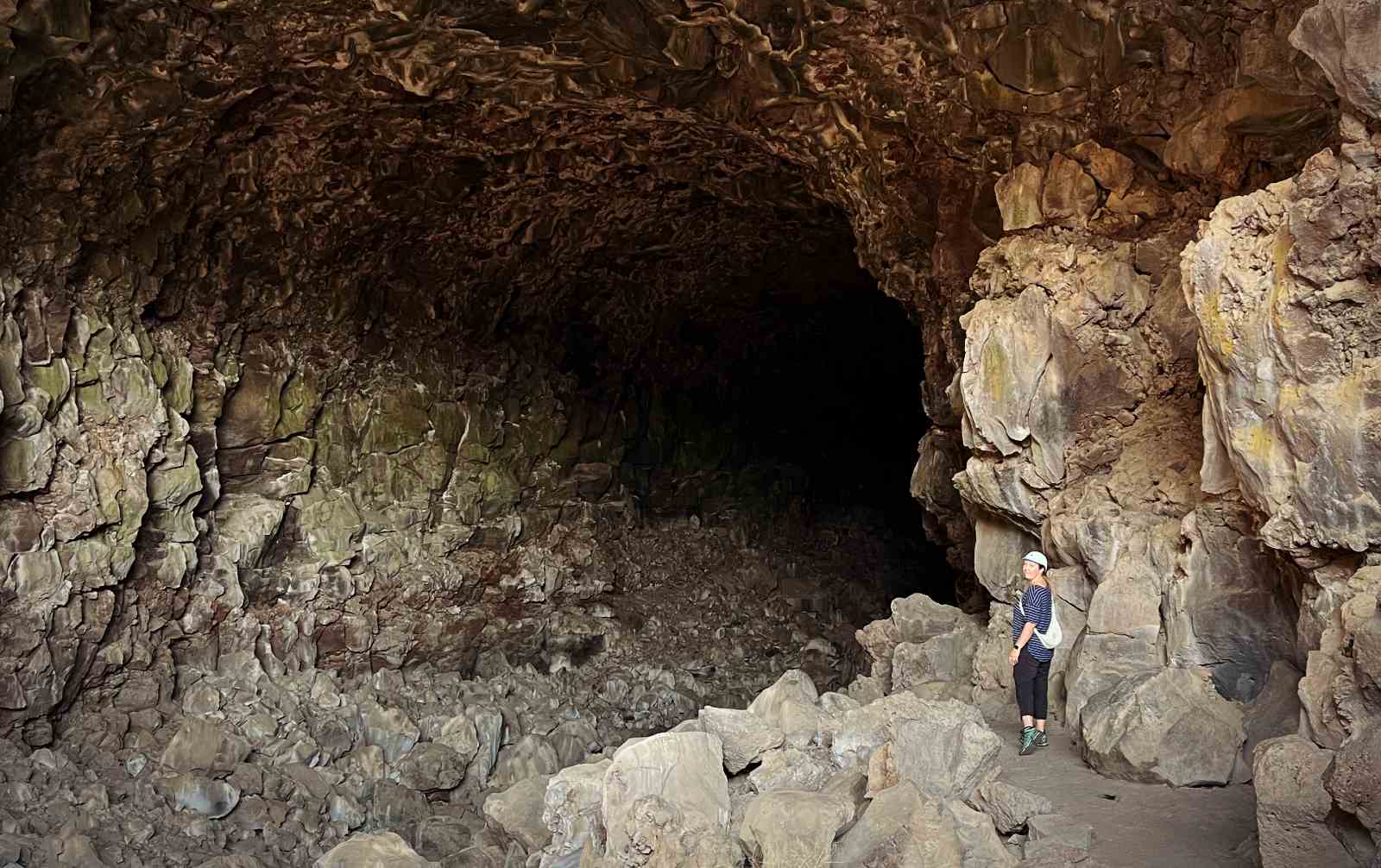
Planning Lava Beds with kids? Explore top family hikes, easy cave trails, and outdoor adventures for all ages.
*We use ads so we can pay for our travels and continue to bring you free travel advice. We also use affiliate links. If you make a purchase through them, we may receive a small commission at no cost to you. See our Privacy Policy for more information.
This fall, we packed up the car and headed north, way north, right to the California-Oregon border to visit Lava Beds National Monument. And let us tell you, it completely surprised us in the best possible way. We loved it so much that we turned right around and came back for the second day to keep exploring.
At Lava Beds, you can crawl, climb, and wander through dozens of lava-formed caves, each one feeling like its own little adventure. On top of that, the park is full of hiking trails and fascinating historical sites that give real depth to the landscape. Over two days, we explored multiple caves and learned about the area’s history, and somehow, it all turned into one big, unforgettable adventure.
This place was an absolute win, especially with kids.
What exactly is Lava Beds National Monument?
Lava Beds National Monument was formed by eruptions from Medicine Lake Volcano, which has been active for at least 500,000 years. Its most recent eruption was about 950 years ago. The volcano sits within the Cascade Range, which stretches from Northern California all the way through Oregon and Washington and up into British Columbia, Canada.
What makes this area so special is the sheer variety of volcanic features packed into one place. Unlike Mount St. Helens, which erupted violently, Medicine Lake Volcano is believed to have erupted slowly and more gently. That calmer activity created an incredible landscape filled with lava tube caves, fumaroles, cinder cones, craters, and vast lava fields.
Medicine Lake sits just beyond the main Lava Beds area and was formed inside a volcanic caldera; a massive depression created when a volcano collapses in on itself. That same dramatic process gave us Crater Lake, the deepest lake in the United States, located not too far away.
Lava Beds National Monument has been protected since 1925, when it was designated a national monument by President Calvin Coolidge.
You will find Lava Beds right along the California-Oregon border, and getting there is part of the adventure. We approached from the south, where you can choose between two nearly equally long routes. The faster option follows Interstate 5 over Mount Shasta; another active volcano, because why not? The more scenic route winds past Lassen Volcanic National Park and near the stunning McArthur-Burney Falls, a detour that’s absolutely worth your time if you have it.
If you are visiting in winter, be prepared for snow. Road conditions and cave access can change with the weather, so flexibility if key.

In other words: it’s a giant, natural playground shaped by fire and time, -and the kind of place that sparks curiosity, imagination, and a whole lot of family wonder.
Are you looking for a place to stay close to Lava Beds? This is our favorite hotel.
Visiting Lava Beds and its highlights
The main attraction at Lava Beds National Monument is its many lava tube caves. Lava tubes form when hot lava flows beneath a hardened surface. When the lava flow eventually drains away, what’s left behind is an empty cave.
We’ve visited lava tubes before at Hawai’i Volcanoes National Park, but those caves didn’t come close to comparing with the ones at Lava Beds.
A visit to the park is best started at the Visitor Center. That’s where you’ll find all the essential information about the caves and trails, pick up any needed gear, use the restrooms, and refill water bottles.
Upon entering the park, every visitor goes through a White-Nose Syndrome check, as bats live in the park’s caves. White-Nose Syndrome is a fungal disease that has killed millions of bats across the Unites States and North America since the early 2000s. While it mainly spreads from bat to bat, it can also be carried into caves on visitors’ clothing.
This type of inspection was already familiar to us from other cave parks, such as Pinnacles National Park and Great Basin National Park in Nevada. During the check, the ranger asks about recent cave visits, and in some cases footwear may be disinfected if visitors have recently been in other caves.
Getting from cave to cave in the park is straightforward with the map provided at the entrance. However, most caves require driving between them, as the area is quite large. There are 28 marked caves though some are usually closed to safety concerns or bat nesting seasons. Depending on difficulty, it’s realistic to visit about four to six caves in a day.
This time, we focused on the easier and more family friendly caves since we were traveling with kids. And looking back, even those felt plenty exciting at times.
Easy caves (marked with a green circle)
Just behind the Visitor Center is a great and easy first cave: Mushpot Cave. It’s lit and features informational signs explaining cave life and how the lava tubes were formed. It’s the perfect place to begin your cave adventure.

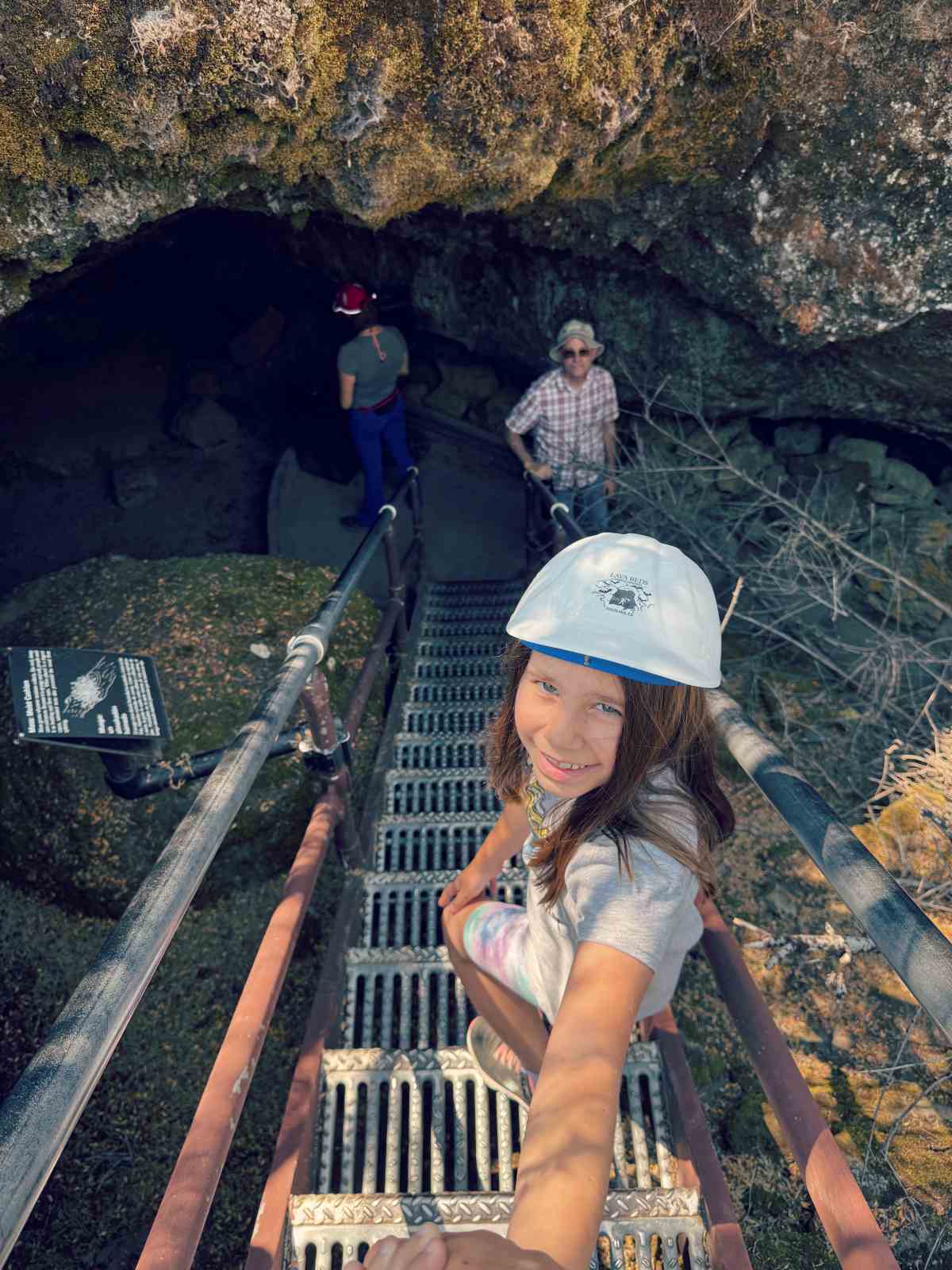
After our first cave, we headed to one of the park’s “ice caves”. Skull Cave is spacious and easy to walk through, but reaching the bottom requires descending a very steep set of stairs. With the darkness and the stairway combined, this was when we truly realised how important a headlamp is compared to handled flashlight -keeping your hand free makes it much easier to hold on the railings.
The stairs were steep enough that our older daughter, who occationally struggles with dizziness, decided to turn back halfway up.
Skull Cave gets its name from the human and animal skulls that were found at its base. The cave stays so cold that ice forms on the floor year-round and you might even see some icicles.

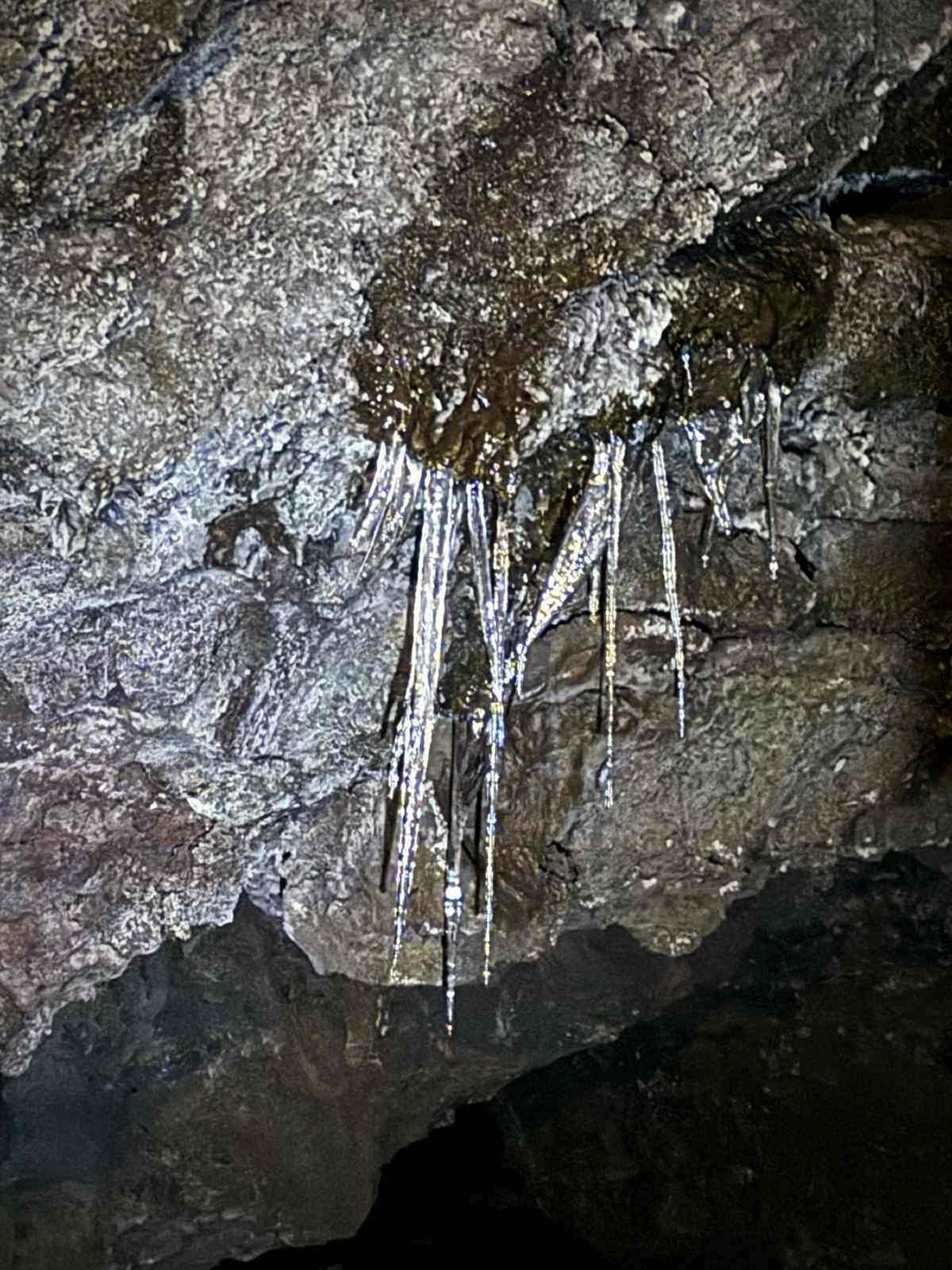
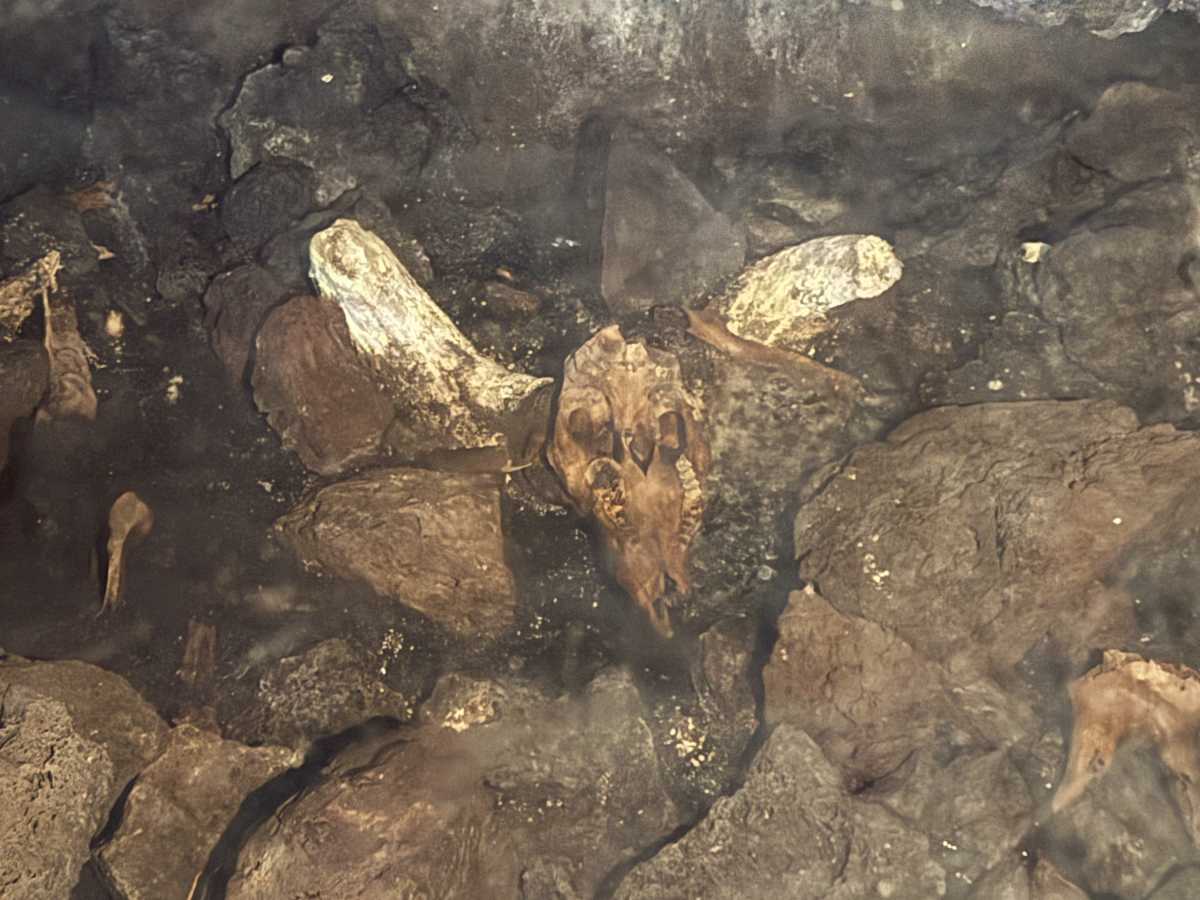
Sentinel Cave is the only cave in the area where you can exit through a different opening than one you entered. It’s a long cave, and at times you need to carefully make your way over rocks along the path. Those parts might be challenging for small kids. In some sections, you also have to duck to get through lower areas. We even spotted a bat near the cave’s second entrance.

Out of all the caves we visited, Valentine Cave was our favorite. It was discovered on Valentine’s Day in 1933 and named accordingly. Right at the entrance, the cave splits into two separate paths that later merge back into a single passageway.
The cave was easy to navigate, though at times we had to duck and even crawl. Its rounded shape gave it a unique feel, and we explored its dark passageways completely on our own.


Other easy caves include Merrill and Heppe Ice Caves, Big Painted Cave, Symbol Bridge Cave, Ovis Cave, and Oasis Cave. We were especially interested in Big Painted Cave and Symbol Bridge Cave because of the rock art found inside. But accessing them would have required hiking, and by then it was already getting late. Some of the other caves were closed during our visit.
Moderate caves (marked with a blue square)
Moderate caves require more crouching and crawling, and moving through them is more challenging due to rocks and uneven terrain. These caves are best explored with proper gear, including a good headlamp, a helmet or hat, gloves, and knee pads.
Some of the most popular moderate caves are Golden Dome Cave, which you descend into using a ladder, and Blue Grotto Cave, where the walls glow blue in certain sections. Right at the entrance to Golden Dome Cave is the infamous “headache rock”, named for how easy it is to bump your head on it.
Other moderate caves include Sunshine, Indian Well, Balcony, and Boulevard.
Difficult caves (marked with a black diamond)
The most difficult caves in the area are recommended only for experienced cave explorers. There caves are more complex to navigate, often multi-level, and involve frequent crawling. Detailed maps for these caves are available at the Visitor Center, and it’s highly recommended to review them before entering. Proper equipment is also essential.
Some of the difficult caves include Labyrinth, Lava Brook, Hercules Leg, Juniper, and Thunderbolt. One of the most intriguing is Hopkins Chocolate Cave, said to look as though its walls are coated with chocolate. The most challenging cave in the area is Catacombs which is an extremely long cave with many branching passages, and in some sections, it’s only about 12 inch (30 centimeters) high.
Captain Jack’s Stronghold Trail
Captain Jack’s Stronghold is one of the most significant historical sites in Lava Beds National Monument. It was here that the Modoc War took place, when U.S. Army forces attacked the land of the Modoc people after the tribe refused to leave the area voluntarily.
The fighting took place during the winter of 1872-1873, and it took the army more than five months to defeat the Modoc, who used lava-formed caves and natural fortifications as shelter amid snow and harsh weather. Eventually, the Modoc were forced to surrender. Most were imprisoned and sent to Oklahoma. Several tribal leaders, including Captain Jack, were publicly executed, while others were sent to Alcatraz in San Francisco.
Today, two hiking trails loop through the area, allowing visitors to see the lava fortifications used during the war. The shorter trail is 0.5 miles (just under one km) long, and the longer trail is 1.5 miles (2.4 km). The trail is easy to walk, but it’s important to watch your step, as rattlesnakes are common in the rocky terrain. We also saw a large number of butterflies and lizards, making wildlife spotting easy along the way.
I highly recommend visiting this area as the story is deeply moving. At one end of the trail stands a medicine pole, where descendants of the Modoc people still leave prayer ties and remembrance items today.


Nature at Lava Beds National Monument
All kinds of small creatures live inside the caves at Lava Beds, but the ones you’re most likely to encounter are bats. Since bats live in darkness, flashlight beams can disturb them, so it’s best not to actively search for them inside the caves. The easiest place to spot them is near cave entrances at dusk, when they head out to look for food.
Sixteen different bat species live in the caves at Lava Beds. Some of the hibernate in the park’s caves during the winter, while others migrate to warmer places, such as Mexico.
We happened to spot one bat near the entrance of Sentinel Cave. Judging by its ears, it may have been a long-eared bat.
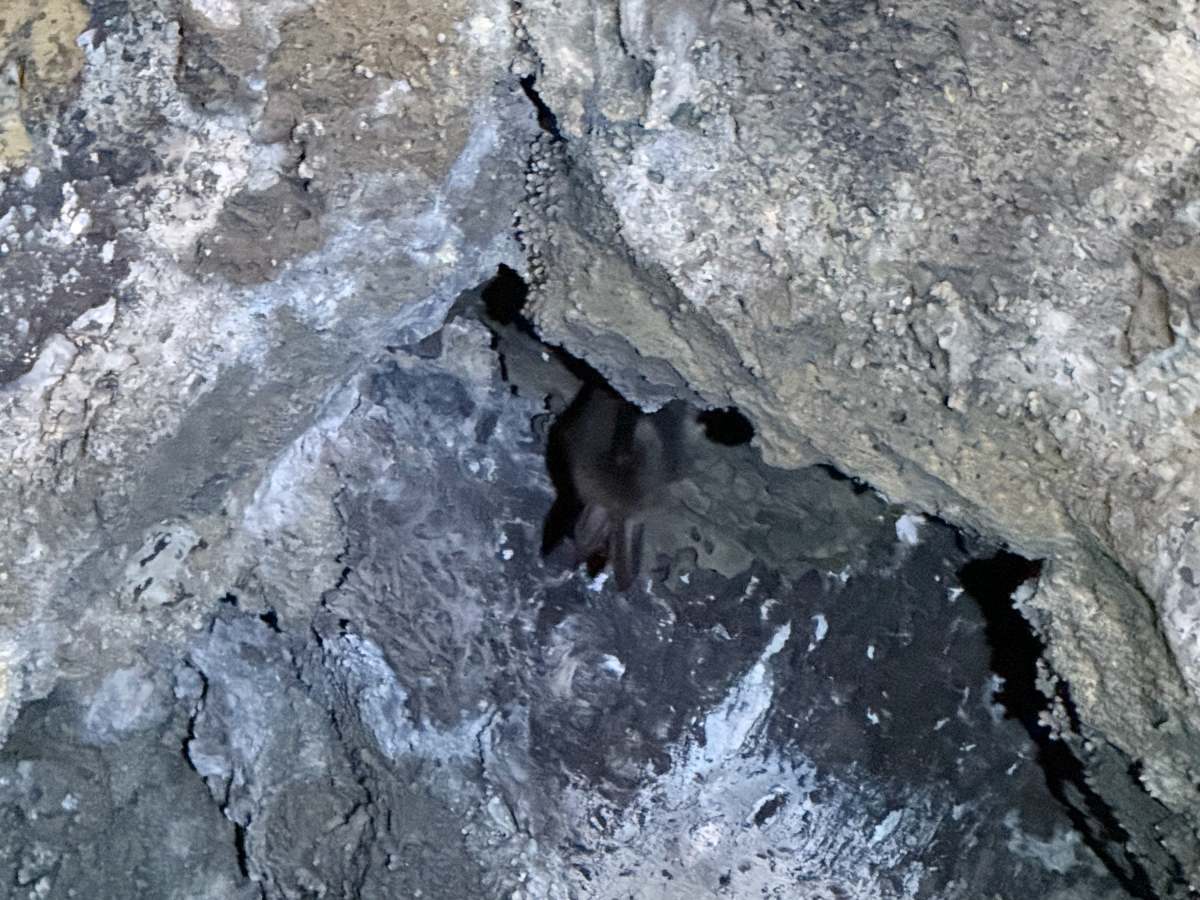
At the entrance of one cave, we were lucky to enough to see a rubber boa snake. Unfortunately, I was so surprised that I didn’t manage to snap a photo before it slipped away. These snakes like cool areas near cave openings and are completely harmless. Still, it’s wise to stay aware of where you place your hands and feet at Lava Beds, as rattlesnakes also live in the area.
Otherwise, during our visit we mostly saw grasshoppers, butterflies, and lizards. In the spring, Lava Beds is also a wonderful place to spot wildflowers.


What to bring for a cave adventure
It’s worth preparing in advance for exploring the caves so you can make the most of your day. A good flashflight or, even better, a headlamp is absolutely essential. Only one cave in the park is lit; all the others are completely dark. Headlamps are especially helpful because they keep your hands free when you need to steady yourself against cave walls or railings.
I also recommend wearing a sturdy protective helmet inside the caves. It’s surprisingly easy to bump your head on low ceilings, and it really hurts. I learned this the hard way more than once, thinking a baseball cap would be enough. Protective helmets are sold at the Visitor Center for $8, and flashlights can be borrowed there free of charge.
For moderate and difficult caves, gloves and knee pads are also recommended, as you’ll often need to crawl through tighter sections.
We brought packed lunches with us, since there are no restaurants or food vendors anywhere in the park. A generous amount of water and sunscreen is also necessary, as inland California is typically hot and sunny.
Where to stay and eat
We approached the area from the south and stayed in the city of Redding, where we’ve spent the night on several of our past trips. Over time, our favorite place to stay has become the Best Western Plus Hilltop Inn, known for its especially friendly service and a truly great breakfast. The hotel also has a pleasant pool area that the kids always enjoy.
In Redding, we’ve had dinner both at the hotel’s own restaurant, which is excellent, and at the fun and casual Lumberjacks restaurant. We also always make a stop at Dutch Bros drive-through for coffee (and smoothies for kids) before hitting the road. From Redding, it’s still over a two-hour drive to Lava Beds, so we made sure to leave early our coffees in hand.
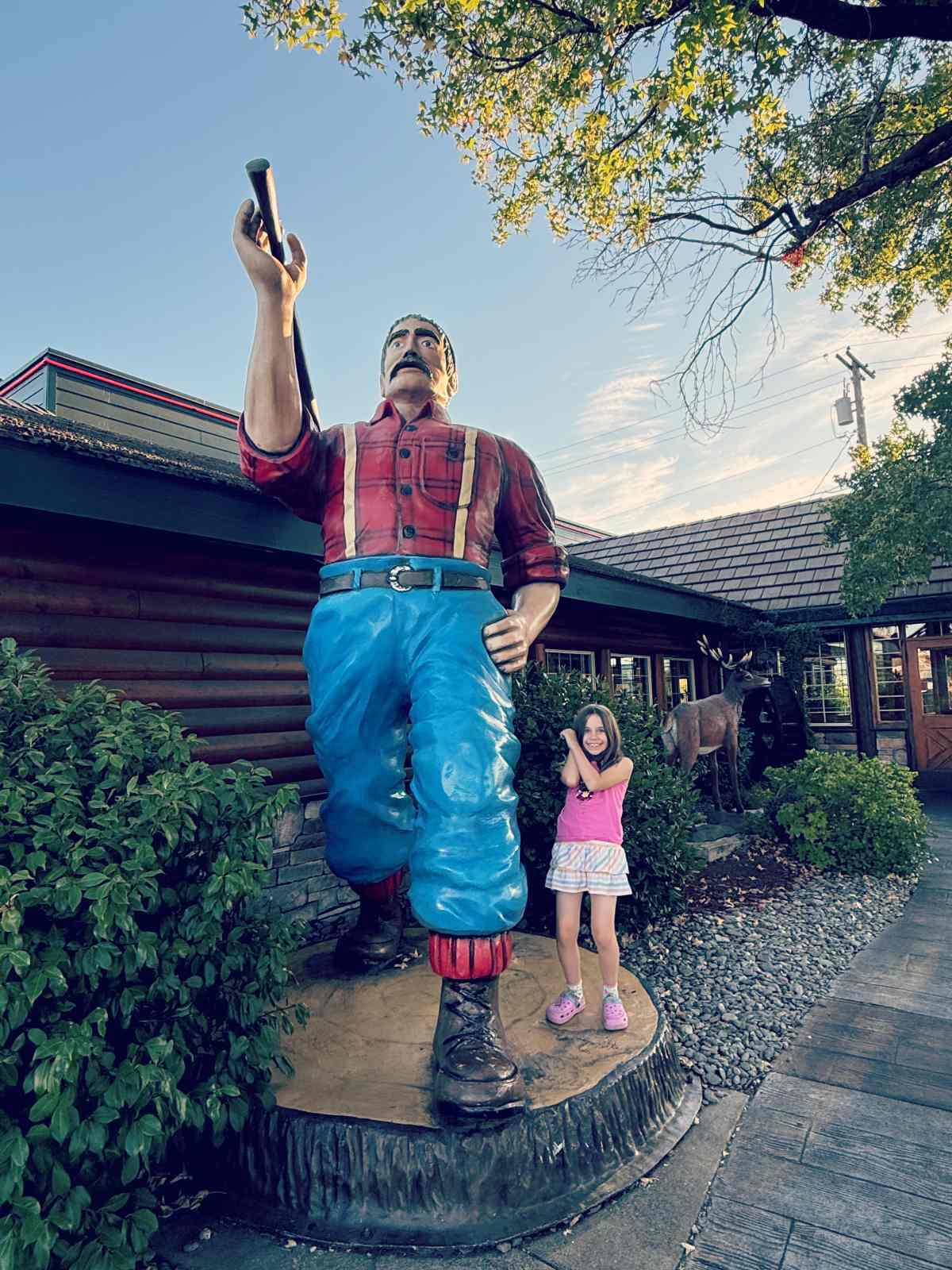

The city also has a lovely small botanical garden called McConnell Arboretum & Botanical Garden, which is worth adding to your list if you’re interested in plants. Nearby, you’ll also find the beautiful Whiskeytown Lake, where we’ve gone swimming, especially near the scenic Crystal Creek Falls.
The closest accommodation option for visitors to Lava Beds is just across the Oregon border in the small town of Merrill. Wild Goose Lodge is a motel-style stay, but it’s a very well-liked option among travelers.
Most visitors, however, choose to stay in Klamath Falls, which is less than an hour’s drive from both Lava Beds and Crater Lake. We stayed at Microtel Inn & Suites by Wyndham. It was perfectly fine for one night, but next time I would choose Shilo Inn or Best Western Plus Olympic Inn -both were unfortunately fully booked during our visit.
At Klamath Falls we had dinner at Wubba’s BBQ Shack and it was great.
🔦🔦🔦
We truly loved our visit to Lava Beds National Monument. It felt like one of California’s hidden gems that is rarely talked about, but far more fascinating than we had expected. Judging by the lack of crowds, it seems many others don’t yet realize what a special place it is. In several caves, we had the entire space to ourselves.
A visit to Lava Beds pairs well with other nearby parks. Crater Lake National Park and Lassen Volcanic National Park are both easy combine into the same trip, and there’s even a joint pass available for all three parks. Along the way, it’s also worth stopping at what many consider California’s most beautiful waterfall: McArthur-Burney Falls.
For us, visiting Lava Beds meant we had finally explored all of California’s national parks and national park units. There 28 protected sites in total, including 9 national parks.
Have you ever explored lava-formed caves like these somewhere?
🇺🇸 OUR USA TRAVEL RESOURCES 🇺🇸
🗝 Hotels & Vacation Rentals: We usually find the best hotel deals here and also check this site.
Vacation homes and condos we book through VRBO.
🚗 Car Rentals: We compare rental car prices on DiscoverCars to find the best deals worldwide.
🗺 Tours & Activities: We usually book tours through Viator or GetYourGuide.
Both have huge selections and easy cancellation.
🎫 Concerts & Events: We buy event tickets through Ticketmaster, one of the most reliable platforms.
✈️ Flights: AirHelp has helped us claim compensation for delayed and canceled flights.
It can sometimes help finding better prices and also protects Wi-Fi when traveling.
📞 Travel eSIM & Data: For mobile data abroad, we use Yesim so we can navigate and stay connected.
🩹Travel Insurance: We always travel with insurance and use SafetyWing on our trips.
For more pictures and videos, check out our Instagram @paulagaston


