

Explore the Arlanza Wine Route in Spain, a hidden gem with family-run wineries, historic villages, beautiful landscapes, and excellent wines.
*We use ads so we can pay for our travels and continue to bring you free travel advice. We also use affiliate links.
If you make a purchase through them, we may receive a small commission at no cost to you. See our Privacy Policy for more information. This trip was made possible by TourSpain, but as always, all opinions are my own.
On my latest trip to Spain, I had the chance to explore the Arlanza Wine Route in the autonomous community of Castilla y León. Along the way, we found small medieval towns, countryside landscapes, art, nature, and plenty of great food and wine experiences.
The wine route turned out to be a really rewarding experience. Looking back, I was surprised by just how much there was to see and do along the way. It is definitely worth considering if you are interested in wine and winemaking, or if you want to explore a wine region that is still away from the crowds found in some of the better-known wine destinations.
Wines of the Arlanza region
The Arlanza wine region (D.O. Arlanza) is best known for wines made from the Tempranillo (Tinta del País) grape. The wines are medium- to full-bodied, but they also have a nice freshness that makes them easy to pair with many different types of food.
The wines get much of their character from the cool nights and clay soils found in the region. The vineyards sit at elevations of around 750-1,200 meters (2,460-3940 feet) above sea level, so nighttime temperatures are considerably cooler than in the valleys below.
Most of the wineries in Arlanza are small family-run businesses that continue to use traditional winemaking methods.
In addtition to Tempranillo, red wines in Arlanza are made from Garnacha, Mencía, Cabernet Sauvignon, Merlot and Petit Verdot. Smaller amounts of rosé and white wine are also produced, using grape varieties such as Albillo and Viura.
The Arlanza Wine Route and Things to See Along it
The Arlanza Wine Route is often described as the “Arlanza Triangle” formed by the towns of Lerma, Covarrubias, and Santo Domingo de Silos. There are other small towns in the area as well, but many of the wineries and attractions can be found around these three.
The wine route runs through the provinces of Burgos and Palencia and largely follows Arlanza River.
One of my favorite things about this wine route is that you can still find plenty of peaceful places along the way. It is not like some of the better-known wine regions in France or Napa Valley in California, where popular wineries can be so busy that you need to make a reservations well advance. And, in many cases, you can end up paying quite a lot for the experience.
You will, however, want a rental car to explore the route. The easiest way to start the trip is in Madrid where you can easily pick up your car from the airport. From there, head toward the town of Lerma, which takes about two hours by car.
Lerma
The Medieval Old Town of Lerma
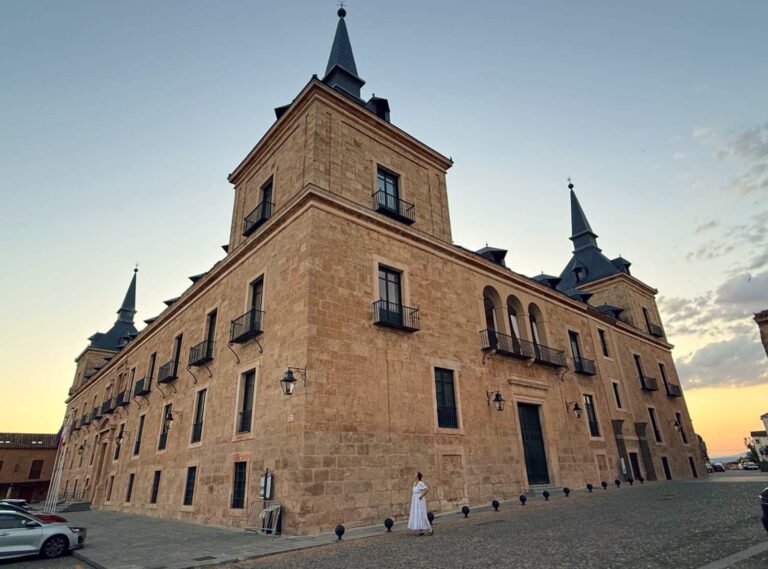
Lerma is a great place to start exploring the Arlanza Wine Route. Much of the historic center of this medieval town was built by the Duke of Lerma, Francisco Gómez de Sandoval y Rojas. The most impressive building is the duke’s former palace, El Palacio Ducal de Lerma.
Lerma is not a very large town, but there are still quite a few things to see along with opportunities to taste local wines. It also makes a good base for taking shorter day trips around the region.
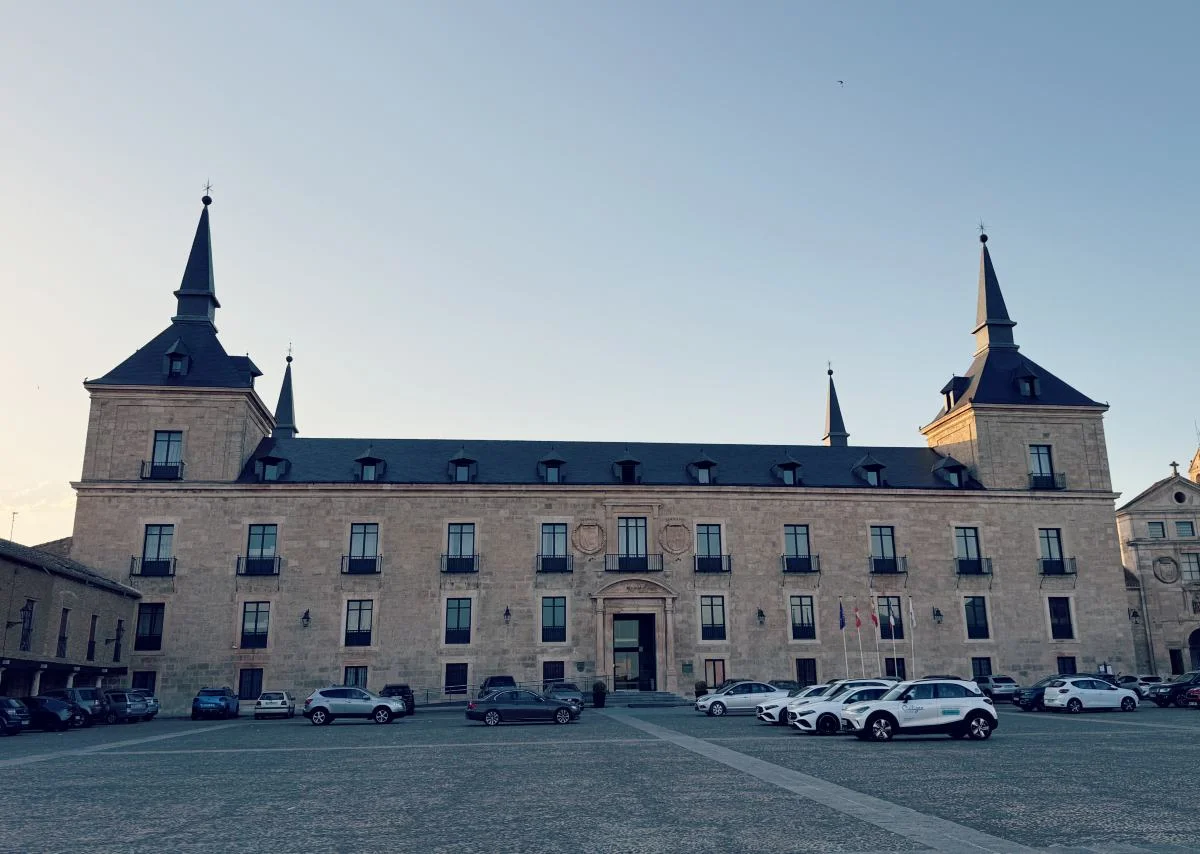
Where to stay: The most impressive place to stay in Lerma is definitely El Palacio Ducal de Lerma, now known as the Parador de Lerma. It is a beautiful historic property and, in my opinion, one the highlights of staying in Lerma.
Posada de Eufrasio is another good hotel option, with rooms decorated in a lovely Rococo style.
Where to eat: There are plenty of restaurants in Lerma, with everything from traditional tapas to pizza. We ate at our hotel, Parador de Lerma, as well as at a restaurant close to our hotel called Asador de Eufrasio. I especially recommend the latter if you want to try some traditional local dishes.

Bodegas Palacio de Lerma
Bodegas Palacio de Lerma is a family-run winery that has been passed down through several generations. Its tasting room is just a few minutes’ drive from the center of Lerma. The winery focuses on preserving the traditional winemaking methods that have been passed down from one generations to the next.
This was one of the most interesting experiences of the whole trip. We had the chance to create our own wine blends under the guidance of the winery’s owner, Ramiro García Arnáiz. He also gave us a detailed look at how the winery operates and how the wines are made.
You can visit the winery independently, and they also offer different wine experiences for groups, including blind tastings.
📍Location: N-I, Km, 203, 09340 Lerma, Burgos


Monasterio de Lerma
Just outside the center of Lerma you will find Lerma Monastery (Monasterio de Lerma). The monastery dates back to 1608 and was home to Carmelite nuns from 1610 until 2016.
Now that the monastery is no longer used for its original purpose, it hosts different events, celebrations, wine tastings, and guided tours. You can also buy products made at the monastery, including different jams, spreads, and wines.
During our visit, we got to take a comprehensive tour of the monastery and also cook some traditional dishes there. You can read about our experience of cooking in the old monastery here.
📍Location: C. el Carmen, 2, 09340 Lerma, Burgos


Territorio Artlanza Art Village
Territorio Artlanza is an art park built by one man, Félix Yáñez. The idea for his own art park started when he began decorating the area around his workshop and noticed that people started coming from farther away to see it.
During Spain’s economic crisis in 2008, Yáñez was having hard time selling his ceramics. Instead, he focused on developing the area around his workshop together with his farther and father-in-law. Eventually, it grew into a complete recreation of a medieval village, with facades, squares, bars, and museums. The village was inspired by Covarrubias, which I will tell you more about below.
The entire park has been built using recycled materials. During the 2020 lockdowns, Yáñez also added a children’s area filled cartoon characters.
Territorio Artlanza is open every day and is located between Lerma and Covarrubias. It is an easy place to stop if you are driving between the two towns, and it is also a fun stop for families with children. There is a souvenir shop at the park as well.
📍Location: C. el Molino, 20, 09347 Quintanilla del Agua, Burgos


Covarrubias
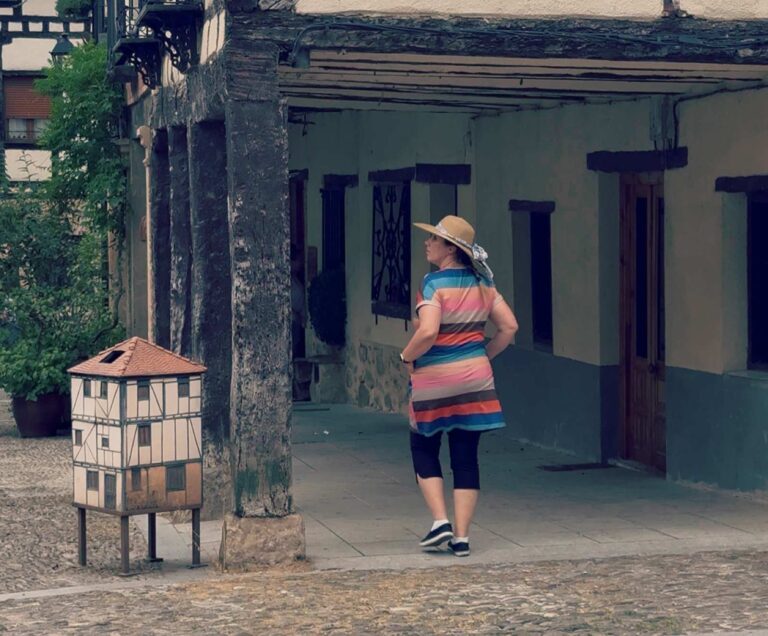
Covarrubias is a picturesque medieval town that is worth stopping in, even just for its unique architecture. The houses in the old town are built in the traditional Castilian half-timbered style, often featuring stone floors, arcaded walkways, and upper-floor balconies that extend over the street.
Covarrubias is also home to a beautiful church with an interesting connection to Norway. Princess Kristina of Norway is buried there. She died in Covarrubias in 1262, four years after she had married Philip I of Castile and moved to Spain. There is also a statue of the princess in the square in front of the church.


Bodega Covarrubias
In the Covarrubias area you will find Bodega Covarrubias, whose tasting room is open daily. It is a traditional family-run winery, and if you are lucky, you may also get to visit its 12th-century underground wine cellar beneath the tasting room.
The winery produces wines from Tempranillo grapes grown at elevations of more that 1,000 meters (3,280 feet) above sea level. These are among the highest-altitude vineyards in Spain.
You may also come across Bodega Covarrubias under the name Viña Valdable.
📍Location: Calle Gómez Salazar 4/18, 09346 Covarrubias, Burgos


Santo Domingo de Silos
Santo Domingo de Silos is a charming small town about 30 kilometres (18,6 miles) west of Lerma. Its main attraction is the monastery in the center of town, Monasterio de Santo Domingo de Silos.
Only around 260 people live in Sanot Domingo de Silos, and the town is surrounded by impressive medieval walls. Walking along its small and peaceful cobblestone streets really made me feel like I had stepped into another time. The atmosphere was especially lovely as the evening started to set in.

Where to stay: There are two hotels in the center of Santo Domingo de Silos, Hotel Tres Coronas de Silos and Hotel Santo Domingo de Silos. If you don’t mind a short walk into the center, I would also recommend the beautiful Convento San Francisco where we stayed. It’s a lovely hotel housed in a former convent, and I really enjoyed our stay there.

Monasterio de Santo Domingo de Silos
Santo Domingo de Silos Monastery (Monasterio de Santo Domingo de Silos) is known both for its beautiful Romanesque architecture and for the Gregorian chants performed by the monks who live there.
The monastery itself dates back to the Visigothic period, although the oldest surviving parts of the current buildings are from the 11th and 12th centuries. The walls, columns, and ceilings feature beautiful carvings and artwork. Inside the monastery, there is also a museum featuring 18th-century pharmacy equipment, including a collection of Talavera jars.
Talavera ceramics are made by hand from clay using a traditional technique. Authentic Talavera ceramics from Mexico have been recognised by UNESCO as Intangible Cultural Heritage, although the original roots of Talavera pottery are actually in Talavera de la Reina in Spain, where these particular pieces also originated.
The monks of Santo Domingo de Silos also became internationally famous for their album Chant, released in 1994. It remains one of the best-known recordings of Gregorian chant and went double platinum after its release.
The monastery welcomes visitors, and you can also visit the church to hear the monks perform their chants several times a day.
📍Location: C. Santo Domingo, 1, 09610 Santo Domingo de Silos, Burgos


Sad Hill Cemetary
Sad Hill is a cemetary that was built as a filming location for the Good, the Bad and the Ugly. It is only about 15-minute drive from the center of Santo Domingo de Silos.
The western the Good, the Bad and the Ugly premiered iin 1966, starring Clint Eastwood. Several other “spaghetti westerns” were also filmed at Sad Hill, but eventually the cemetery was forgotten and fell into disrepair. It was restored in 2015 and turned into a tourist attraction.
We have visited filming locations like this before, including Top Gun and Breaking Bad locations. Sad Hill is a little different because the entire cemetery was built specifically for the movies.
Sad Hill is especially worth a stop if you are a fan of westerns or Clint Eastwood.
📍Location: 09613 Contreras, Burgos


Yecla Gorge
Yecla Gorge (Desfiladero de La Yecla) offers a short and easy hiking trail in the Sabinares del Arlanza-La Yecla Natural Park, about 3 kilometres (1,8 miles) from the center of Santo Domingo de Silos.
The gorge was carved by erosion as the Helechal stream carried water toward the Mataviejas River, gradually wearing away the limestone walls. The gorge took millions of years to form, but today you can walk through it along metal walkways and trails built into the rock.
The actual gorge section is about 600 meters (0,4 miles) long, but the trail continues beyond it as a regular path. Many birds nest on the rocky cliffs above, including griffon vultures, which kept a close eye on us during our visit. The area is also home to one of the best-preserved juniper forests in the world.
We have hiked through similar narrow canyons before, including Antelope Canyon in Arizona and Mojave Desert in California, and I always find these kinds of places fascinating.
📍Location: BU-910, 09610 Santo Domingo de Silos, Burgos


Palencia
Bodegas de Baltanás
Baltanás is a real treat for wine lovers, thanks to its long and rather unique winemaking traditions. Just outside the town center is a hill called Cerro del Castillo, which is home to a remarkable complex of 374 underground wine cellars, known as Bodegas de Baltanás.
The exact age of the wine cellars is not known, but they are believed to date back to around the 17th century. At the time, it was common for families to make their own wine. Both the winemaking and storage took place underground.
The advantage of these cellars, dug into the clay soil, was that the temperature and humidity remained relatively stable throughout the year. The cellars are arranged on six different levels, giving the entire complex a somewhat pyramid-like appearance. Each cellar also has its own chimney-like ventilation shaft, which helps circulate air and also carried away carbon dioxide produced during winemaking.
Some of the cellars are still in use, with local growers making wine for their own consumption. Other have fallen into disrepair and some have even collapsed. The town has, however, recognised the importance of preserving this historic site. There is also a small museum at the cellars where visitors can learn more about their history.
📍Location: Diseminado Diseminados, 138, 34240 Baltanás, Palencia


Where to eat: In the middle of the Baltanás wine cellars, you will find a real gem that you shouldn’t miss. La Zarcera is an award-winning fanily-run restaurant serving traditional dishes made with local ingredients, as well as more modern and creative creations.
The food was excellent, the winers were wonderful, and the owners were incredibly warm and welcoming. Having dinner here was such a lovely experience!
La Zarcera also has its own wine cellar in the basement of the restaurant.


Bodegas de Torquemada
Bodegas de Torquemada is a little similar to Bodegas de Baltanás, but these wine cellars were not built into a hill. Instead, they were dug into flat ground.
Torquemada has almost 500 wine cellars, and together with their straight streets, they form what feels like an entire underground wine village. The area has been proposed for Bien de interés Cultural status, recognising its cultural and historical importance.

Valladolid
Our tour ended in the city of Valladolid, which has a population of around 300,000. Valladolid is commonly known by its nickname Pucela, although the exact origin of the name is not known.
Valladolid is a historically important city and was once the capital of Spain. In the city center, it is worth taking some time to admire the historic buildings and their Renaissance architecture. Some of the best-known landmarks include Valladolid Cathedral, San Pablo Church, and Pasaje Gutiérrez.
Valladolid is also known for its delicious tapas and numerous bars.
We have also visited a city called Valladolid in Mexico, so it was fun to see if the two cities had anything in common. The Mexican Valladolid got its name during the colonial period, when the Spanish arrived in the area. You can also see Spanish colonial influences in many of the buildings and European-style squares there.


Where to stay: We stayed at the recently renovated Barceló Hotels & Resorts. It was very nice and in a great central location. When choosing a hotel in Valladolid, I would recommend staying somewhere within walking distance of the main sights.
Where to eat: If you want to try something a little different, I definitely recommend Los Zagales de Abadia. Their tapas are both fun and delicious. At first glance, some of them didn’t even look like food! The restaurant has won several awards for its innovative dishes.


🍷🍷🍷
Overall, the Arlanza Wine Route was a really pleasant surprise, and I was also impressed by the wines from the region. It is definitely a hidden gem for anyone looking for a future wine travel destination!
For those who want to a get a feel for Spain before their trip, there is plenty of great literature to enjoy. And for all wine lovers I would recommend a film called; Rioja, la tierra de los mil vinos.
Have you explored any wine routes around the world?
🇪🇺 OUR EUROPE TRAVEL RESOURCES 🇪🇺
🗝 Hotels & Vacation Rentals: We usually find the best hotel deals here and also check this site.
Vacation homes and condos we book through VRBO.
🚗 Car Rentals: We compare rental car prices on DiscoverCars to find the best deals worldwide.
🗺 Tours & Activities: We usually book tours through Viator or GetYourGuide.
Both have huge selections and easy cancellation.
🎫 Concerts & Events: We buy event tickets through Ticketmaster, one of the most reliable platforms.
✈️ Flights: AirHelp has helped us claim compensation for delayed and canceled flights.
📞 Travel eSIM & Data: For mobile data abroad, we use Yesim so we can navigate and stay connected.
🩹 Travel Insurance: We always travel with insurance and use SafetyWing on our trips.
For more pictures and videos, check out our Instagram @paulagaston