

Planning a trip to northern Spain? Here’s why Monasterio de Lerma is one of the most unique places to visit in the Burgos region.
*We use ads so we can pay for our travels and continue to bring you free travel advice. We also use affiliate links.
If you make a purchase through them, we may receive a small commission at no cost to you. See our Privacy Policy for more information. This trip was made possible by TourSpain, but as always, all opinions are my own.
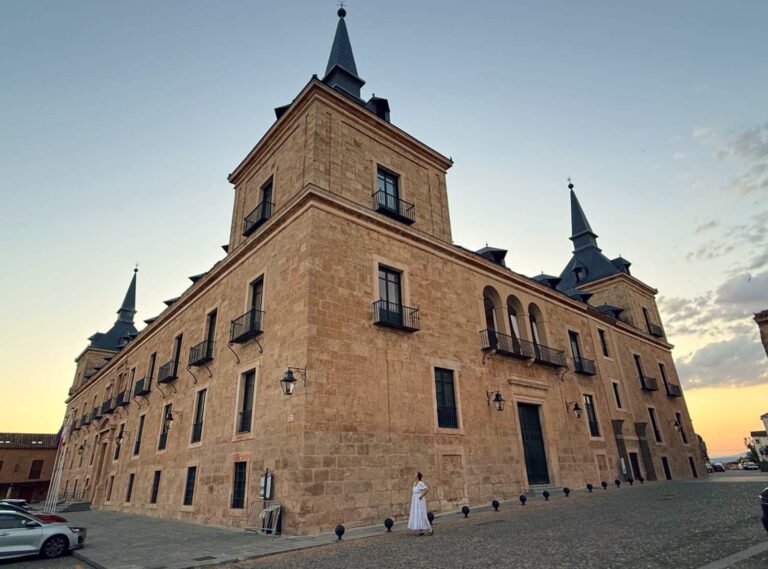
This summer, I spent nearly a week exploring the beautiful Burgos region of Spain, visiting its historic landmarks and renowned wineries. One of the most memorable stops of the trip was the historic Monasterio de Lerma, a former monastery in the charming village of Lerma that now hosts special events, culinary experiences, and guided tours.
We spent almost an entire day at Monasterio de Lerma cooking, enjoying an incredible meal, and learning about the monastery’s fascinating history. It turned out to be one of the highlights of our entire trip. Our host, Diego, welcomed us with genuine warmth and shared the story of the monastery with so much passion that the experience felt truly special. It was without a doubt one of the most memorable moments of our journey in Spain.
Monasterio de Lerma is located in the picturesque village of Lerma, in the province of Burgos within Spain’s Castile and León region. The nearest major tourist destination is Madrid, which is about a two-hour drive away, making Lerma an easy day trip or a worthwhile stop on a road trip Northern Spain.
Monasterio de Lerma: A Former Carmelite Monastery
Monasterio de Lerma dates back to 1608 and was home to a community of Carmelite nuns from 1610 until 2016. For more than four centuries, the nuns lived a quiet, secluded life behind the monastery walls, rarely leaving except under extraordinary circumstances.

The Carmelite Order is part of the Roman Catholic Church, and its name originates from Mount Carmel in present day Israel. The first Carmelites were forced to leave the Holy Land during the 13th century after Muslim forces took control of the region, eventually establishing communities throughout Europe.
The Carmelite nuns dedicated their lives to prayer, study, and craftsmanship while embracing a lifestyle of simplicity. Their commitment to poverty was reflected in every aspect of their daily life. They typically walked barefoot or wore only the simplest sandals, and their living quarters were intentionally very plain, with few personal items.


In Monasterio de Lerma the nuns grew vegetables, raised livestock, and produced many of the items they needed themselves. To support the monastery, they also sold handmade goods, including baked treats, jams, honey, and crafts.
One interesting feature in the monastery was the torno, a revolving wooden turntable located near the entrance. Customers would first ring a bell in order to get the attention of the nuns. Then they would place their orders and receive their purchases through this rotating cabinet, allowing the nuns to remain completely hidden from view and preserve their cloistered way of life.


The Carmelite nuns called Monasterio de Lerma home until 2016, bringing more than 400 years of continuous monastic life inside these walls to an end when they decided to move.
A New Chapter for the Monastery
Today, Monasterio de Lerma has been given a new purpose. The historic monastery now hosts private events, wine tastings, and guided tours. In addition to the traditional daytime tour, you can also join a unique evening tour by candelight, where actors dressed as Carmelite nuns bring the monastery’s history to life.
One of the monastery’s most unforgettable experiences is “The Lord Walks Among the Pots and Pans”, a hands-on cooking experience inspired by centuries-old monastic traditions. Guests prepare a meal the old-fashioned way, using clay pots and cooking over an open fire.
Each of us received our own clay pot and filled it with ingredients of our choice, including beans, a variety of meats, chorizo, and fresh vegetables before adding water.
Once everything was ready, the pots were placed in the warm hearth to slowly simmer for several hours. Throughout the afternoon, our host Diego carefully tended the fire, adding hot coals whenever needed to keep the stew cooking at the perfect temperature.


While our stew was slowly cooking, we also learned how to make one the region’s most traditional specialities in the monastery courtyard: blood sausage. Unlike blood sausage served in other parts of Spain, this local version also contains rice just like I am used to having in blood sausage in Finland.


The food cooked for about five hours, and while we waited, we sampled the monastery’s own wine, enjoyed a variety of spreads with fresh bread, and took a guided tour of the monastery and its gardens.


When the stew had finally become tender after hours of slow cooking, we gathered in the monastery’s old dining hall, where the tables had been set to for us.
The Carmelite nuns once ate their meals here in complete silence, but the atmosphere was quite different with our group of journalists and bloggers. And the food we had prepared was absolutely delicious.


Cooking in traditional clay pots was a truly unique experience. It’s not every day you get to prepare a meal in such beautiful and historic surroundings.
If you don’t have time to spend an entire day at the monastery cooking, I highly recommend joining one of the guided tours instead. The building is beautiful, full of history, and the story of the Carmelite nuns who once lived there is fascinating.
Our hosts clearly put their hearts into what they do, and they made our day at the monastery truly unforgettable.
🥘🥘🥘
Lerma was the first stop on our trip, and it turned out to be a fascinating medieval village. We stayed at the beautiful Parador de Lerma and also visited a local winery.
From there, we continued along the Arlanza Wine Route, stopping in Santo Domingo de Silos to visit its monastery, the art village of Artlanza, Sad Hill, where several spaghetti Westerns were filmed, the beautiful village of Covarrubias, and finally Valladolid where we ate some award-winning tapas in Los Zagales restaurant.
Overall, it was a truly fascinating region to explore!
🇪🇺 OUR EUROPE TRAVEL RESOURCES 🇪🇺
🗝 Hotels & Vacation Rentals: We usually find the best hotel deals here and also check this site.
Vacation homes and condos we book through VRBO.
🚗 Car Rentals: We compare rental car prices on DiscoverCars to find the best deals worldwide.
🗺 Tours & Activities: We usually book tours through Viator or GetYourGuide.
Both have huge selections and easy cancellation.
🎫 Concerts & Events: We buy event tickets through Ticketmaster, one of the most reliable platforms.
✈️ Flights: AirHelp has helped us claim compensation for delayed and canceled flights.
📞 Travel eSIM & Data: For mobile data abroad, we use Yesim so we can navigate and stay connected.
🩹 Travel Insurance: We always travel with insurance and use SafetyWing on our trips.
For more pictures and videos, check out our Instagram @paulagaston



The cooking session at Lerma monastery is ⭐️⭐️⭐️!
It was truly an amazing experience. 💎